The NCS matching engine, in depth
I did not set out to build employment infrastructure. I set out to stop answering the same question.
Through my early years of a B.Tech in Delhi, someone asked me most days what language they should learn, or what career path was right for them. After a few hundred of these conversations I noticed how I was actually answering. I was not looking at anyone's degree. I was combining three things: what they had studied, what they could actually do, and what they were drawn to.
That was an informal model running in my head, so I tried to automate it.
The first version was a RAG-based career recommendation system. Upload a resume, complete a behavioural assessment, then talk to it. I tested it on myself first, and it identified gaps in my own profile with more specificity than I expected. That was the moment I thought there was something here. It was also the moment I understood it was a good demo and not yet a product.
The real signal came later. The next time friends asked me career questions, I told them to use the system first and come back only if it did not resolve things. That change in my own behaviour was the beginning of Zobique.
The actual problem
The demo became a product only after I started talking to students, professors, and eventually placement teams.
From inside a university the problem looks different. Student information sits across resumes, spreadsheets, forms, assessment results, and placement records. A single coordinator can be responsible for thousands of students against a constantly changing set of openings. Matching ends up dependent on manual filtering and human judgment under time pressure.
Guidance had a second problem. Generic advice is easy to produce: learn Python, improve communication, build projects. None of it answers the question that matters, which is what this specific person should do next, given where they stand today and what the market is asking for.
That reframed things for me. The gap was not a lack of AI in career guidance. It was that no structured representation existed of what a person currently knows relative to what a job actually requires. Once that is missing, everything downstream gets harder: matching, recommendations, gap analysis, learning paths, placement decisions, recruiter discovery.
So I stopped thinking of the product as a chatbot. The chatbot was an interface. The real problem was representation and matching.
What I built
Two coupled layers. A matching engine answering which opportunities are relevant to a person, and a skill-gap engine answering why that person is not ready for them yet.
The second question turned out to be the important one. Telling a student they are a 61 percent fit for a role does not tell them what to do on Monday morning.
Representing the candidate. A profile is not one large blob of text. The system combines structured and unstructured signals: education, projects, skills, experience, assessment results, preferences, and stated objectives. Skills are normalised so the system does not depend on the exact words a student happened to use. A student writes "MERN". A posting says "JavaScript, React, Node.js, and MongoDB". Those have to connect. The output is a candidate skill and career representation, not a resume embedding.
Representing the job. Same idea. A posting carries required and preferred skills, experience and education requirements, responsibilities, role type, seniority, and location, held as both semantic and structured information.
Hybrid matching. My first instinct was pure semantic retrieval. That works well for a prototype and breaks as the system becomes consequential. A candidate can be semantically similar to a role while failing a hard requirement, and two roles can use completely different language for the same capability.
So the pipeline runs representation, retrieval, constraint checks, relevance scoring, then ranking. Semantic similarity finds relevant opportunities. Structured attributes block obviously wrong ones. It is closer to how an experienced placement professional thinks, except it runs consistently across a far larger candidate set.
The skill-gap layer. For each relevant role, the system compares what the role requires against what the candidate demonstrates. The output is not "missing: Python". It answers which requirements are met, which are partially met, which gaps matter most, which repeat across several target roles, and what to build or learn next.
Skills come from both directions. From the job, extracted and normalised. From the candidate, inferred from evidence. A resume rarely says "I know REST APIs". It says "built a backend service using FastAPI and PostgreSQL". The system has to reason over evidence rather than match keywords.
Profiles are also not binary. Someone can have no exposure, theoretical knowledge, a small project, substantial project work, or professional experience. The system has to separate the presence of a skill from the strength of evidence for it. Models help with extraction and interpretation, but they should not be free to invent a student's capabilities.
I wrote more about that last point in Make the model abstain, and about what a gap actually is in What a skill-gap actually is.
Architecture
Next.js and React for the interface, FastAPI and Python for backend services, PostgreSQL for structured data, a vector store for retrieval, Redis for caching and async work, LLM APIs for extraction and reasoning, and a mix of Playwright, BeautifulSoup, and direct APIs for ingestion.
The flow: ingestion and parsing, structured profile and job representation, embeddings and retrieval, matching, requirement comparison, gap analysis, recommendations.
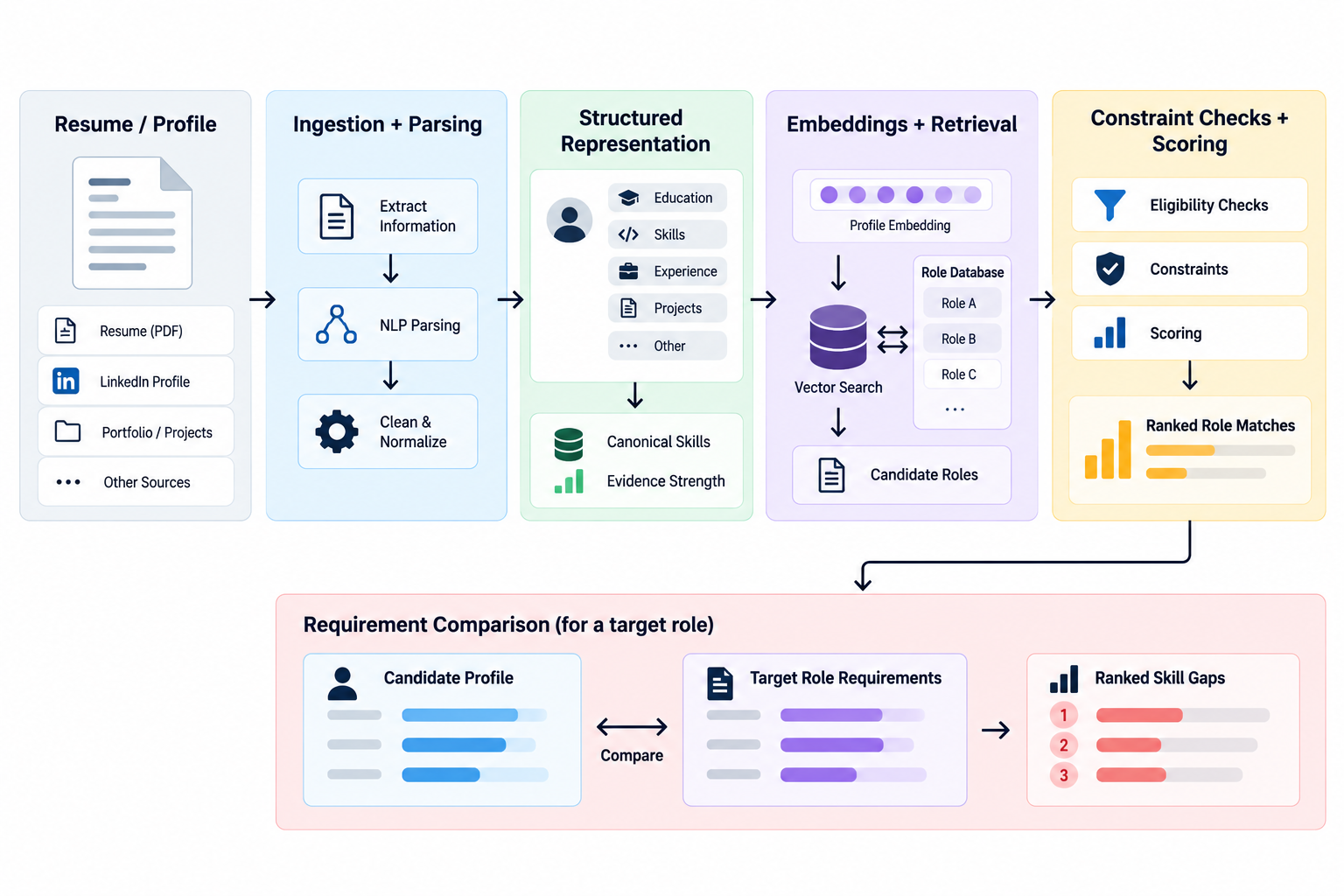
The decision that mattered most was separating data representation from generation. The LLM is not the database and not the source of truth about a student. The system stores structured information, retrieves relevant evidence first, and the model reasons over that context. That made the system controllable.
Integrating with the National Career Service
The next step was integrating the technology with the National Career Service, the employment platform operated under the Ministry of Labour and Employment, Government of India.
This changed the engineering problem. A prototype tolerates ambiguity. A production integration does not. Inside your own product you control the interface, the input format, the pipeline, and the failure conditions. An external employment ecosystem introduces constraints you do not control.
The integration sits around the same core intelligence layer. Data arrives through an integration layer, gets processed into our representation, runs through matching and skill intelligence, and returns structured results. Implementation details of government systems are deliberately not described here.
The engineering lesson is the abstraction. The intelligence engine should not need to know much about the system sending it data. It receives a well-defined representation, does its work, and returns a predictable result.
The prototype had assumed clean inputs. Real employment data is not clean: inconsistent text, incomplete profiles, uneven job description quality, missing fields, the same skill expressed five ways. The integration was never "connect an API to a model". It was a test of whether the representation and processing pipeline could survive outside a controlled environment. That was the actual milestone.
What broke
This is the part worth documenting. The interesting work was never getting the first demo running. It was everything after.
Resume parsing. Students use Word, Canva, and a dozen resume builders. Some PDFs have proper text layers, some do not. Tables, unusual headings, skills buried inside paragraphs. A parser that handles ten hand-picked resumes looks excellent and becomes a different system entirely against thousands of arbitrary ones. Parsing is not preprocessing, it is part of the product. If the candidate representation is wrong, everything downstream can be wrong while still producing a convincing looking answer.
Skill vocabulary. MERN, full-stack JavaScript, React plus Node, web development. Not identical, but treating them as unrelated produces poor matching. We needed semantic understanding combined with normalised skills, so the system could see relationships between terms without collapsing them into one thing.
Cold start. The hardest student to help is the one with almost no information: a degree, a thin resume, no projects. This produced a principle I now apply everywhere. The system should know when it does not know enough. Rather than manufacturing precision, it should identify the missing signal and ask for it. In career guidance, false confidence is worse than no recommendation.
Non-determinism. LLMs are excellent at interpreting messy human language and are also probabilistic. If the model decides everything, the same candidate can receive different guidance on different days. That is unacceptable when the output affects someone's employment. So the model has boundaries: extraction, interpretation, and reasoning over retrieved evidence. Application logic stays deterministic wherever it can.
Evaluation. The hardest conceptual problem. There is no clean ground truth for a correct career recommendation. A student getting hired does not prove the recommendation was right, and a student ignoring one does not prove it was wrong. So instead of one accuracy number we use several signals. For matching: did relevant roles rank near the top, were clearly irrelevant ones excluded, did human reviewers agree. For gaps: were the missing skills actually missing, was there evidence behind each one, did students find the output actionable. The question is not whether the model is accurate. It is whether the whole system makes better decisions than the process it replaces.
Cost. Every additional student adds parsing, embedding, retrieval, and inference cost. At ten users, architecture barely matters. At 1,500 it matters. At institutional scale it becomes product economics. That pushed us toward caching, separating expensive operations from lightweight retrieval, cutting unnecessary model calls, and matching the model to the task instead of using the most capable one everywhere.
Trust. The last failure mode was not technical. A recommendation can be correct and still be ignored. Students do not act because software told them to. They need a reason, evidence, and a clear next step. That is why I stopped optimising purely for match quality and started optimising for actionability.
What happened
The system was piloted across 2 universities with 1,500+ students, contributing to 50+ placements.
That placement figure needs care. The system was part of a broader career and placement process, not the sole cause of any hire. Placements involve student preparation, university processes, recruiter requirements, interviews, and timing.
The more useful conclusion is not the number. It is that the intelligence layer held up against real student populations rather than curated demo profiles.
The aggregate data confirmed something I had suspected. Students usually know the destination they want long before they understand the capability gap between where they stand and that destination. A job board tells you what exists. A chatbot tells you what to consider. A matching engine tells you what you are suited for. A skill-gap engine tells you where you are, what the market wants, and what to do next. That is a more useful primitive.
What I would redesign
Build evaluation before building more intelligence. My instinct was to make recommendations better. I should have first built a fixed evaluation set of anonymised candidate and job pairs with human-labelled relevance and known failure cases. Without it, a more impressive demo is easily mistaken for a better system.
Treat the skill ontology as infrastructure. Early systems treat skills as strings. Production systems cannot. Skills contain other skills, sit adjacent to each other, and split into tools, concepts, and capabilities. That representation deserves to be real infrastructure rather than a side effect of prompting, because it eventually powers matching, gap analysis, learning paths, recruiter search, and workforce analytics.
Do not put the LLM at the centre. Resume in, LLM answers, is fast to build and very hard to control. I would start from data, representation, retrieval, and deterministic logic, then add model reasoning only where needed, then validation.
Design for bad data from day one. The clean demo dataset is a trap. I would build the first evaluation set deliberately from ugly resumes, vague job descriptions, duplicate skills, and missing fields. The real world should be the test set.
Separate intelligence from distribution. This is what the NCS work taught me most clearly. The engine should not be coupled to one frontend, one university, or one platform. The reusable asset is the intelligence layer, and different interfaces sit above it.
Where this goes
Matching itself is becoming commoditised. The asset I care about is a structured representation of what a person can currently do versus what a role requires. That supports placement intelligence for universities, career planning for students, candidate discovery for recruiters, and a clearer view of talent readiness for employers. It is the direction we are taking this work at Zobique.
The first version of this project answered my friends' career questions. The later version had to survive resumes that would not parse, skills without consistent names, incomplete profiles, inference costs, and institutional constraints.
Building an AI demo is mostly about making the model work. Building an AI system is about making everything around the model work reliably. That difference is where most of the engineering lives.
Links
- Deployment write-up for the shorter summary
- Featured by India Today, a founder story on building Zobique while pursuing a B.Tech
- Built with Mohit Kholiya and Vansh Attri