Why voice agents feel robotic
Most people imagine voice AI as a single exchange: you speak, the system understands, it replies. Building one taught me that this exchange is powered by a stack of specialized systems running in parallel under a latency budget most software never has to think about. Understanding what happens behind that one exchange is the first step to understanding why so many voice agents still sound robotic, and what it actually takes to fix that.
The stack behind one exchange
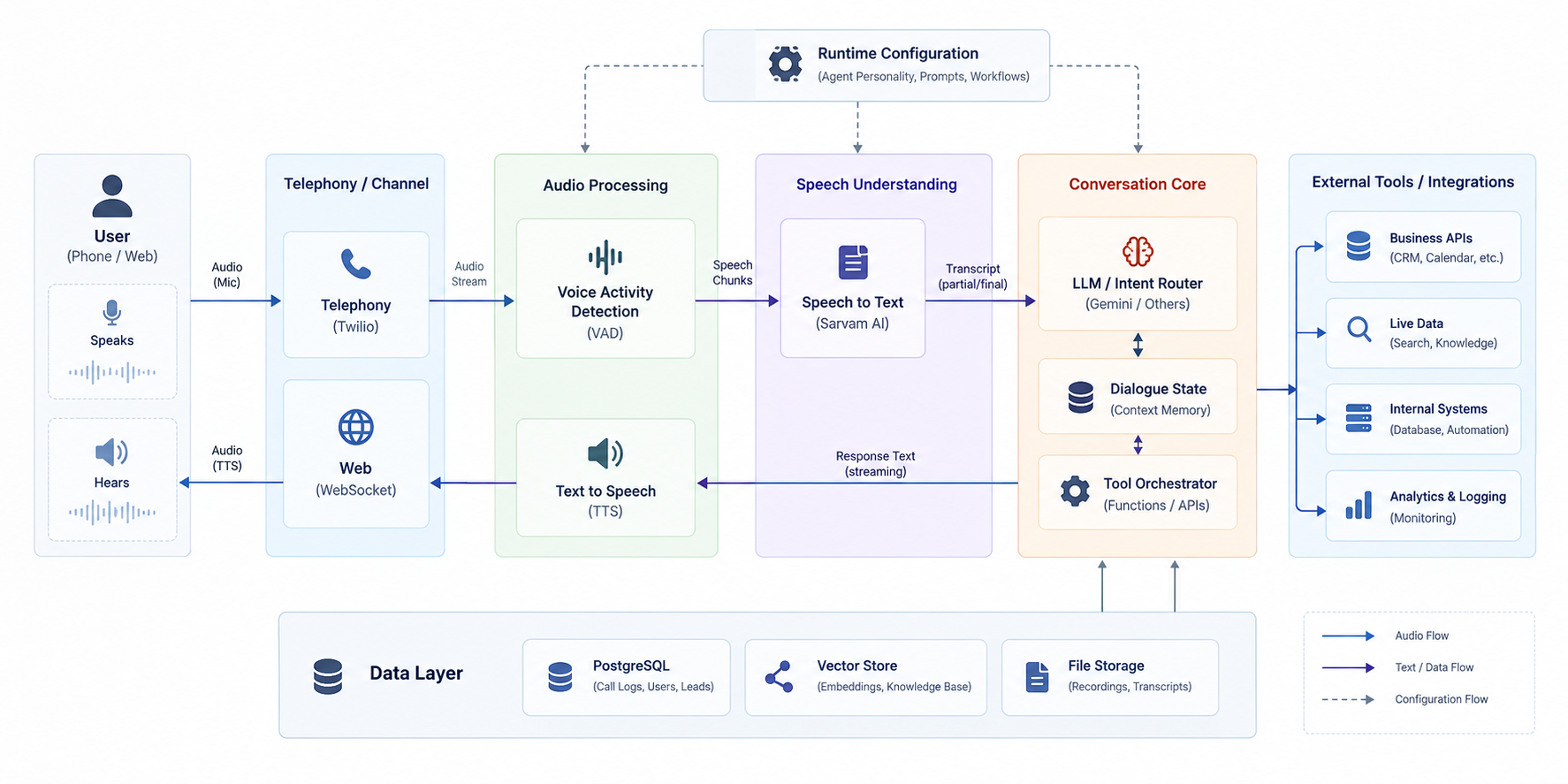
A production voice agent is not one model. It is at least six coupled systems, each with its own latency, its own failure modes, and its own trade-offs:
- STT (speech-to-text). Converts spoken audio into text.
- TTS (text-to-speech). Converts generated text back into natural-sounding speech.
- VAD (voice activity detection). Identifies when a person is actually speaking versus background noise.
- Telephony. The infrastructure that carries the call itself.
- Reasoning (LLM). The model that interprets intent and generates a response.
- Agents / execution. The layer that takes action, updating a CRM, checking availability, triggering a workflow.
Stitching those together well is most of the engineering difficulty, and it is also where robotic behaviour quietly creeps in. This is roughly the shape of what I ended up building for a real-estate lead-qualification agent: a realtime voice engine sitting between telephony and an async backend, with separate workers handling dialling and structured extraction so the call itself never blocks on slower work.
What "robotic" actually means
When people say a voice agent sounds robotic, they rarely mean just the tone of the synthesized voice. Almost every time, it traces back to one of five structural issues.
Acoustic degradation and telephony compression. Phone networks compress and degrade audio in ways clean, studio-quality training data never accounts for. Background noise, hold music, an IVR answering instead of a person, sometimes just silence. Distorted or ambiguous audio reaches the STT engine before the conversation has even started, and every downstream stage inherits that error.
Latency across the full stack. Natural conversation runs on split-second timing. Once the combined delay across STT, reasoning, and TTS creeps past a few hundred milliseconds, the pause becomes noticeable and the exchange starts to feel mechanical. On a screen, a two-second delay reads as a loading state. On a phone call, it reads as the system being broken. Voice is the one interface where responsiveness is not a nice-to-have, it is part of what the listener perceives as intelligence.
Turn-taking and barge-in. Real conversations are messy. People interrupt, trail off, talk over each other. An agent that cannot detect and handle barge-in gracefully either keeps talking over the caller or freezes mid response, and either one breaks the illusion immediately. Handling this correctly means the audio pipeline has to be listening and ready to cut off generation while it is still speaking, not just between turns.
Multi-intent and unstructured context. Real callers rarely ask one clean question at a time. They combine intents in a single sentence, backtrack, change direction mid-call. An agent that only tracks the current turn loses the thread and gives answers that feel disconnected from what was actually said two sentences earlier.
Execution coupled to conversation. A voice agent is often expected to do more than talk: look something up, check a calendar, write structured notes back to a CRM. When execution and conversation are not cleanly separated, a slow database write or a dead API call stalls the dialogue, and the caller hears the stall as dead air.
None of these are model-quality problems. They are systems-engineering problems, and they are the actual reason an agent feels lifeless even when the underlying models are individually impressive.
What actually fixes it
Pick the right model for each job, not one model for everything. Very few teams build their own STT or TTS in-house; the investment is enormous and the return, relative to buying it, is poor. The real work is evaluating providers per component against four criteria that trade off against each other: accuracy, cost, speed, and language support. A provider that is excellent for English STT can be mediocre for a regional language, which matters a great deal if the calls are not all in English.
Build a parallelized, streaming pipeline, not a request-response chain. Waiting for each stage to fully finish before starting the next adds up whole-sentence delays. A pipeline built on continuous WebSocket connections can start LLM inference on partial transcripts as they arrive and stream TTS output in small audio chunks, often before the model has finished generating the full sentence. This is the single highest-leverage change for perceived responsiveness, more than swapping to a faster model.
Use VAD to filter noise, not just to detect speech. Without a proper VAD layer, a system treats any sharp sound as an interruption, which is a real problem on calls made from crowded metros, moving vehicles, or open offices. A robust VAD layer is what lets the agent tell genuine speech from ambient noise instead of getting derailed by every passing sound, and it is usually underinvested relative to STT and TTS.
Separate reasoning from execution. Conversation and action are different jobs and belong in different processes. In the diagram above, the realtime voice engine only holds the call open; a dial worker and an extraction worker handle outbound dialling and structured field extraction on their own schedule, polling the same database rather than sitting in the call's critical path. The realtime engine and the backend talk through a narrow config seam instead of a shared call stack. That separation is what keeps a slow CRM write from ever becoming dead air on the line.
Track dialogue state explicitly. This is the most business-critical piece and the easiest to underrate. What the agent says matters more than how it says it. One incorrect statement about a price, a property, or a policy can break trust in a single sentence and send a lead straight to a competitor. Explicit dialogue state tracking gives the reasoning layer a persistent, accurate memory of what has actually been said and confirmed in this call, rather than letting the model reconstruct it from a raw transcript on every turn. It is what protects correctness at scale, once the interesting part of the demo is no longer "does it sound human" but "did it say the right thing."
The bigger picture
None of these five failure modes exist in isolation, and none of the fixes work in isolation either. A voice agent only feels natural when acoustic handling, latency, turn-taking, context tracking, and execution are engineered together as one system, not bolted on as five separate features on top of a single model call. The hard part was never getting a demo call to sound convincing. It was making the same call work on the two hundredth attempt, against real phone networks, real interruptions, and real silence.
Links
- AI voice agent for real-estate lead qualification, the deployment this architecture is drawn from
- Source on GitHub